Posts

HTML5 input type does not submit name for images

I had some very simple code that worked well in the Chrome web browser, but it did not however work with Internet Explorer or Firefox and didn’t generate any errors. The functionality was simply to pass a parameter (in this case ‘auth’) to a PHP page; once on the page I am simply checking that it is set . I was attempting to do this by attaching the parameter to the image input type but was having no joy. Rather than look at alternative options, this made me curious so I went searching. After a bit of digging, I found that the HTML5 spec requires just the x and y coordinates clicked on for the image to be appended to the form data submitted. After realising this, I changed from using the name/value attributes on on the image input type to using a hidden field and all browsers were happy. In terms of my very simple HTML code, to make it work. Before:       <form action="index.php" method="post">      ...

Barcamp Auckland 5

Image
With 300 attendees registered for this year, there were a lot of Web developers, designers, lawyers, investors and others in one place with several un-conference sessions running in parallel at Barcamp Auckland 5. A summary of my interpretation of key points from sessions I attended is below. Write once, run everywhere HTML 5 applications SmartBiller HTML 5 based desktop/iPhoneAndroid app. Used jQTouch as a framework; supports Webkit only. jQuery Mobile wasn’t ready at time, but this would be preference if rebuilding (better support). Sync driven from server. Device detection being done adhoc on client & server side. Would use MVC if writing again. fluidapp.com for Mac wraps any website and makes it appear like an application. Need to consider how to handle multiple open windows Check instancecount then “ping” other instance may be an option. Screen size, browser quirks / CSS, Intera...

Where do I start?

Image
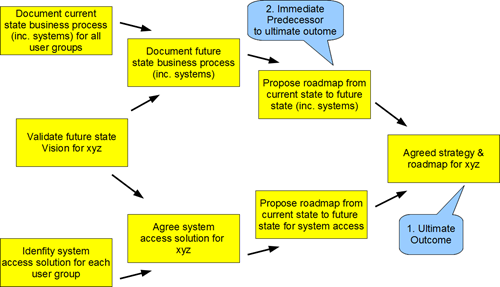
A simple approach I have found works well when thrown something to look at and unsure of where to start is to focus on what you are trying to achieve and working back from that. I first had this approach shown to me using post-it notes (aka sticky notes) and have used this approach (albeit usually with Visio) many times. The steps to follow are very simple: Write down on a post-it note what the ultimate outcome is. Write down on separate post-it notes for each activity or output required what needs to occur before you can get to the ultimate outcome, and stick this to the left of (1). For each task that is a predecessor of (2), write it down and stick it the left and repeat until you are back far enough that you have a plan of attack. The beauty of post-it notes is that you can’t write much on them, so write just enough in simple terms so that you know what is required (which may be outputs, tasks, workshops or anything else of value). It is also easy to add missing...

TOGAF 9 - dry, but some good content

Image
The Open Group Architecture Framework (TOGAF) is a framework - a detailed method and a set of supporting tools - for developing an enterprise architecture, developed by members of The Open Group Architecture Forum. To say that the TOGAF 9 documentation is dry is an understatement. Some areas are lacking in depth and whilst TOGAF is a process framework I would like to see it evolve to have templates, document samples and checklists. There is however some good content and I will be referring back.

Webstock 2011 Presentation

I have uploaded a presentation outlining the key points from each session I attended at Webstock to Slideshare.  Enjoy! Webstock 2011 View more presentations from Simon Gianoutsos This is an accompaniment to the two previous blog posts I have compiled on Webstock 2011: WebStock 2011 - Conference day one WebStock 2011 - Conference day two

WebStock 2011 - Conference day two

Yet another excellent day of thought provoking presentations.  Big thanks to the conference organisers, helpers and presenters for such an excellent event. For my notes from yesterday check out “ WebStock 2011 - Conference day one ”.  The collaborative note taking effort was also in action again today at http://webstock.waveadept.com/ . Marco Arment @marcoarment Do your own thing Co-founder of Tumblr, Founder of Instapaper It’s never too late to edit for the good of your product What to build o    You don’t need to cater to geeks §   We’re not loyal and will jump to new products §   We’re unnecessary as an audience; we’re very small o    Be useful to non-geeks You don’t need to (and probably shouldn’t) rely on another service o    Don’t give your power away. §   E.g. using Facebook for login o    You need them for everything and they use you for nothing o    No service is universal o    You ca...