Posts

How I manage my email
Image
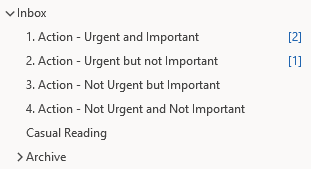
A colleague was noting that he was wanting a better approach to manage his email so I thought I should document what I have been doing for several years now and has been (mostly) working for me. The general concept is that I aim to have nothing in my Inbox at the end of each day.  The approach I have been using builds on top of Getting Things Done (GTD) , Inbox Zero and the Eisenhower Matrix to prioritise it. Ideally as soon as an email arrives and I get around to looking at, I move it to an appropriate folder to action later, respond straight away, file it away in my archive folders or delete it. In reality I often end up going through what is still lingering in my Inbox at the end of the day and do this.  I have some key folders setup: 1. Action - Urgent and Important 2. Action - Urgent but not Important  3. Action - Not Urgent but Important 4. Action - Not Urgent and Not Important Casual Reading  These are the key folders I use for determining the priority of ac...
"Site Reliability Engineering: How Google Runs Production Systems"; my key take-aways

Image
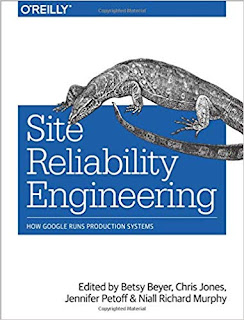
" Site Reliability Engineering: How Google Runs Production Systems " edited by Betsy Beyer, Chris Jones, Jennifer Petoff and Niall Richard Murphy contains a number of insights into Google's SRE practice. It is a bit repetitive at times but this assists in drilling in some of the key points. My key take aways were: Google places a 50% cap on all aggregate "ops" work for all SREs - tickets, on-call, manual tasks, etc. The remaining 50% is to do development. If consistently less than 50% development then often some of the burden is pushed back to the development team, or staff are added to the team. An error budget is set that is one minus the availability target (e.g. a 99.99% availability target will have a 0.01% error budget). This budget cannot be overspent and assists in the balance of reliability and the pace of innovation. Cost is often a key factor in determining the proposed availability target for a service. if we were to build an operate ...

Book Review: "The Culture Code: The Secrets of Highly Successful Groups" by Daniel Coyle

Image
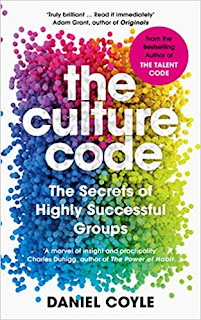
I enjoyed reading "The Culture Code: The Secrets of Highly Successful Groups" by Daniel Coyle. It has lots of great stories about groups in various fields (SEALs, sports teams, corporate environments, creative companies, aircraft crew and more) and the various (often subtle) attributes that makes these teams successful. Key takeaways for me were: Safety is the foundation on which strong culture is built. Our brain is obsessed with psychological safety and we require lots of signalling over and over to feel safe. A sense of belonging is easy to destroy and hard to build. Patterns of interaction of successful groups that have good chemistry often include: Close physical proximity, often in circles Profuse amounts of eye contact Physical touch (handshakes, fist bumps, hugs) Lots of short, energetic exchanges (no long speeches) High levels of mixing; everyone talks to everyone Few interruptions Lots of questions Intense, active listening Humour, laughter...

Book Review: "Seven eLements of Leadership for a New Breed of Leader" by Michael A. Pitcher

Image
Written in an engaging manner with lots of examples based around the Seven eLements of "Laugh, Learn, Listen, Language, Lagniappe, Legacy, Love" I took away a number of good points to consider, many of which were good reminders and some of which were good reinforcement of things I have already been doing. My key takeaways: General Leadership = Influence. And you influence ALWAYS! If you’re in a position to influence the behaviour, thoughts, or feelings of others, then you’re in a leadership role. Coaching is teaching a specific set of skills required for success in a specific situation. Mentoring is sharing wisdom so that the mentee has the opportunity to learn from the life experiences of the mentor. Laugh Authentic leaders show vulnerability and allow others to see their humanity. Laughter is the authenticity that opens the window so others can see inside. Laughter opens the door for meaningful conversations that create meaningful relationships. Humour defuses ...

Book Review: "The Power of Moments" by Chip Heath & Dan Heath

Image
I was listening to a podcast where one of the authors of this book was explaining the concept of "The Power of Moments" and provided some examples that compelled me to buy the book straight away (which is very rare for me). The book is packed with examples and lots of great advice, albeit it is a bit verbose at times. The key concept is that we can be more impactful as leaders and as people by recognising and creating more "moments" / memorable experiences. We can be the designers of moments that deliver elevation, insight, pride and connection. These extraordinary moments are what make lives meaningful. My key takeaways: Three situations that deserve punctuation: transitions, milestones, and pits.  Transitions include first day of work, weddings and graduations. A milestone may be the length of time an employee has been at the company, getting to a key point in a project or completing a marathon. Examples of pits include: a positive response to a service...

Book Review: "Exponential Organizations: Why new organizations are ten times better, faster, and cheaper than yours (and what to do about it)"

Image
Exponential Organizations by Salim Ismail, Michael S. Malone and Yuri Van Geest contains lots of useful information about how to give your organisation a chance of survival (be it a new one or an existing one of any size). It was repetitive at times and at points it felt like a Singularity University sales pitch but there was sufficient useful content for me to deem it a worthy read. My key takeaways: "Once any domain, discipline, technology or industry becomes information-enabled and powered by information flows, its price/performance begins doubling approximately annually."  Ray Kurzweil Rather than owning assets or workforces and incrementally seeing a return on those assets, Exponential Organisations (ExOs) leverage external resources (people, systems, machines etc.) to achieve their objectives. An exception to this is for scarce resources and assets. Maintaining a small core allows significant flexibility.  It also brings in fresh perspectives and expertise. E...

Solution: Getting macOS Messages to work with Google Chat / Talk / Hangouts in High Sierra

Image
The Messages application wasn't working for me on macOS and I was wanting it to work with my Google Chat / Talk / Hangouts service. It appears that with macOS High Sierra a workaround is required. After struggling to get it going I finally got it going after some searching on the Internet and trying a couple of supposed fixes. What ended up working for me were the instructions on  https://forums.macrumors.com/threads/gtalk-messages-solution-found-high-sierra.2073393/ with a couple of tweaks. The tweaks were required to support 2FA which is enabled on my account. The instructions, repeated here so that I can find them again if required and to assist others having the same problem, are as follows: Go to System Preferences / Internet Accounts and delete your google account. Open Terminal and run the following commands (Warning: This will delete your history!): find ~/Library/Preferences -name "*iChat*" -delete rm -rf ~/Library/Caches/com.apple.Messages rm -rf...

Book Review: "The Lean Startup" by Eric Ries

Image
The Lean Startup is a book I have been meaning to read for years and never got around to. It contains lots of useful advice and good case studies explaining experiences of what has and hasn't work. The book is oriented towards software development startups (and software development innovation in general in any sized organisation) and could have easily been condensed into a third its size. Key takeaways: Build, Measure, Learn (go through this loop as fast as you can) Use validated learning and measure using actionable metrics, not vanity metrics. Use cohort analysis. Do split testing to measure what matters to customers Build a Minimal Viable Product (MVP), gain quick feedback from customers, learn quickly and evolve as required Use 5 whys for root cause analysis and identifying what to target in terms of improvements

Book Review: "Sprint: How to Solve Big Problems and Test New Ideas in Just Five Days" by Jake Knapp, John Zeratsky, Brad Kowitz

Image
Sprint is a superb book that is very easy to read, with real world examples of how to apply the techniques discussed. I have taken some of the concepts discussed and am applying them to other activities beyond a 5 day Sprint process. Thoroughly recommended.

CIO Summit 2017 Synopsis

Image
I’ve spent a bit of time at the CIO Summit  in Auckland over the past couple of days and below is a synopsis from the sessions I attended. Key overall themes Digital Transformation (DX) is still a key focus of organisations, with cultural change being one of the most fundamental shifts. Increased use of Cloud/“as a Service” models is prevalent across most organisations. Customer-centricity as opposed to other models such as Product-centric. Connections & ecosystems (internal and external to organisations) is key to DX, with APIs being a key enabler. Smart use of data is becoming increasingly important to drive great customer experiences. Further detail Trends & Insights “The 3rd platform is the key to creating new value” IDG Mobility, Big Data/Analytics, Cloud, Social “By 2020, over 2/3 of Enterprise IT and software spending will be for cloud-based offerings” IDG “70% of CIOs have a cloud first strategy” IDG “By 2019, 42% of IoT data will be process...

IT & Enterprise Architecture Conference 2015 - Day 2

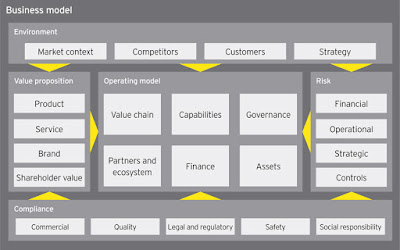
Today was the second and final day of the IT & Enterprise Architecture Conference 2015. Below is a summary of my key notes. Going beyond IT. What EA can really mean for your organisation John Pearson, Business Architect, IAG Consider the Demand vs Supply side of architecture IAG is using traditional TOGAF domains (Information, Application, Technology Infrastructure and Security) with business architecture being used to better align with the demand from the business Enterprise Business Motivation Model (EBMM) - Accenture, Nick Malik ( http://www.motivationmodel.com/ ) anchor diagram for business architecture using to understand change impact Bake business architecture approaches in early in the architecture journey Understand the business, its priorities and where value can be added Understand architecture capabilities in service to the business Understand key stakeholder n...

IT & Enterprise Architecture Conference 2015 - Day 1

Image
Today I attended the first day of the  IT & Enterprise Architecture Conference  2015 at the Crowne Plaza in Auckland. This was my first time at the event and it was a good opportunity to network with the wider IT & Enterprise Architecture community. Below is a summary of my key notes. Setting the scene: Enterprise Architecture 2015-2025 Craig Pitout, Senior Manager IT Advisory, EY ( @CraigPitout ) Cloud, Mobility, Big Data and Social Media are key forces of Digital Disruption Themes affecting enterprise agility Customer centric Product centric Internal efficiency Regulatory requirements Force for uniqueness vs Force for commonality Quantifying the impact Innovation impact vs Value potential Disruptive - disrupt the core Adjacent - change and expand Sustaining - incremental improvements EY Business Reference Model - Agile ( http://www.ey.com/GL/en/Services/Advisory/EY-t...

Gather 2015

I attended the inspirational  Gather 2015 unconference today. As described on the website for the event “It is the digital, technical and creative community’s big day out”. There were several sessions running simultaneously and it was hard to choose what to go to since there were so many interesting topics. Below is a summary of my key takeaways (or interpretations thereof) from the sessions I attended. UAVs, Internet of Things, 3DVR: What are we going to do with these things? How do we get us/our companies/NZ to lead the way? What can we do to take advantage? These are the questions - does the room have the answers? MAKER CHANGE BUSINESS @lancewiggs Future Skynet Remote Monitoring UAV Tour - e.g. rent a UAV and do tour of Egypt Auto-herding GPS in humans Better battery life Sensors inc. in building beams to say if leak problem Track robber Traffic control Drone based terror Evidence-based thinking Data —> Interpretation Auto milk ordering fro...